


Setting up a professional padel court requires expertise and precision in selecting materials and executing all phases of the project to the highest international standards. With so many companies operating in this field, Technotrade remains the best choice thanks to its proven track record of designing and implementing padel courts with professionalism and quality. From selecting the right site, to installation using the latest technology, to post-delivery services, Technotrade ensures that your project is executed with the highest levels of accuracy and speed, making it the ideal partner for anyone looking to create a successful and profitable padel court.
What is a padel court and why has it become a profitable venture?
Padel is a modern sport that has spread widely in recent years, especially in Arab and Gulf countries. Combining elements of tennis and squash, padel is played with smaller rackets and a tennis-like ball on a court surrounded by glass or mesh walls that allow play to continue after the ball bounces.
1️⃣ What is a padel court?
A padel court is a space dedicated to the practice of this sport, and is characterized by special specifications, the most important of which are:
Dimensions: The court is usually 10 meters long and 20 meters wide for doubles, surrounded by glass walls and metal netting.
The floor: Covered with the exchanger’s own artificial turf with a layer of silica sand for added stability.
Chassis: Made of galvanized stainless steel with impact-resistant tempered glass.
Lighting: A powerful lighting system that allows the game to be played day and night.
2️⃣ Why did the padel court project become profitable?
Padel has seen rapid growth, making investing in the sport a golden opportunity for a number of reasons:
🔹 Growing demand
The number of players and clubs offering padel has increased as the game’s popularity has risen globally and in the Arab world, which means a strong demand for padel courts.
🔹 High financial returns
Daily profits can be made by:
Hourly stadium rentals for individuals and teams.
Organize local or friendly tournaments.
Offer paid training classes for beginners.
🔹 Lower operating costs
After the stadium is built, the project does not require significant operating expenses, as maintenance is limited and the artificial turf and glass have a long lifespan.
🔹 Diversity of investment opportunities
The project can be expanded by creating multiple courts, or adding support services such as a cafeteria, a store for game supplies, or a training academy.
صفحتنا علي الفيس بوك
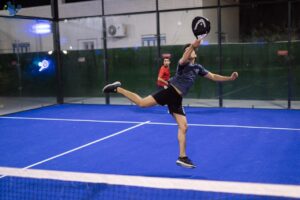
Key components when setting up a padel court
Equipping a professional padel court requires specific components in accordance with the international standards adopted for the sport. These components ensure quality play, safety, and long-term durability. Here are the most important elements that make up a padel court:
1️⃣ chassis
Made of rust and weather resistant galvanized steel.
–It forms the main frame on which the glass and metal grille are mounted.
It is characterized by high rigidity to ensure the stability of the playground for long years.
2️⃣ glass walls
Tempered Glass -10 with a thickness of mm12.
Shock-resistant and able to withstand the pressure of the ball and players.
Provides a clear view from all angles for both players and spectators.
3️⃣ metal grille
Attaches to the top or non-glass sides of the stadium.
Made of galvanized steel wire coated against corrosion.
It prevents the ball from going out and keeps the game going without interruption.
4️⃣ Stadium
Padel artificial turf that withstands friction and heavy use.
Silica sand is placed inside the turf to ensure players’ stability and minimize slippage.
A concrete base layer under the grass with an efficient water drainage system.
5️⃣ lighting system
It relies on powerful LED lighting that is thoughtfully distributed to cover the entire stadium.
Provides clear visibility day and night with low power consumption.
Resistant to external factors such as rain and wind.
6️⃣ Gates and entrances
Secure doors that are easy to open and close.
Made from the same material as the metal body to ensure durability.
Allows for player movement and smooth entry and exit.
7️⃣ Signs and landmarks
Precisely drawn lines to delineate play areas.
Clear colors that are resistant to corrosion and weathering.
8️⃣ Additional accessories (optional)
Seats for spectators.
Storage space for equipment.
Cameras or recording systems.
قراءة المزيد …ارضيات اكريليك للملاعب الخيار الأفضل | المميزات والمعايير
How to install and equip a padel court
Padel has become one of the most popular sports in recent times, increasing the demand for the construction and equipping of professional padel courts of international standards. In order for a padel court to be implemented with high quality, you need to follow deliberate steps and use reliable materials. Here are the basic stages of installing and equipping a padel court:
1️⃣ Site Study and Preparation
Choosing the right location: It should be easily accessible and close to vital areas or sports clubs.
Measuring the space: A 10 x 20 padel court is usually one meter for doubles.
Prepare the floor: Level the ground well, pour a strong concrete base that can support the weight, and set up drainage systems to prevent water from accumulating on the floor.
2️⃣ Installing the chassis
Use galvanized stainless steel to ensure durability and longevity.
Carefully install the basic frame of the playground, which will hold the metal netting and glass walls.
Treat all joints and screws to ensure stability and rigidity.
3️⃣ Glass wall installation
–
Use Tempered Glass panels -10 mm thick to resist 12 shocks.
The glass is securely fastened to the metal frame to ensure safety during play.
Ensure that all boards are even and provide a perfect view of the game.
4️⃣ Metal mesh installation
Place netting in non-glass areas to prevent the ball from going out.
Use galvanized steel wire coated with anti-corrosion material.
Tighten the net tightly to ensure it is stable during play.
5️⃣ Preparing the pitch
Cover the floor with high-quality artificial turf for padel sports.
Add a layer of silica sand inside the turf to increase stability and reduce slippage.
Ensure that the floor is level and free of any defects that affect the movement of the players.
6️⃣ Installing a lighting system
Use powerful LED lights distributed at a deliberate angle to ensure that the entire stadium is covered.
Choose energy-efficient and weather-resistant lighting.
Securely anchor electrical poles outside the play area.
7️⃣ Adding entrances and extensions
Install safe and easy-to-use entry and exit gates.
–Provide spectator seating (optional).
–Clear floor markings and lines to delineate playing areas.
Choosing the right location and space to equip Padel Stadium
Choosing the right location and space is the first and most important step in the success of a padel court project. Even with the best materials and state-of-the-art technology, a project can fail if the location is not well thought out. Here are the key factors to consider before you start setting up a padel court:
1️⃣ Choosing the right location
🔹 Proximity to the target group
Ideally, the stadium should be located near residential areas or neighborhoods where recreational sports are popular.
Choosing a location near universities, sports clubs, or malls increases the likelihood of attracting customers.
🔹 Accessibility
The stadium should be in a location that is easily accessible via major roads.
The availability of public transportation and sufficient parking is a plus for visitor convenience.
🔹 Environment
Choosing a location away from noise or crowded places makes for a comfortable gaming experience.
It is preferable to choose a location that is safe and equipped with basic services such as electricity, water, and sewage.
2️⃣ Selecting the right space
🔹 Standard stadium dimensions
Court for doubles play: 20 10 meters long x meters wide.
–Court for singles play: 20 6 meters long x meters wide.
🔹 Outdoor space
Provide additional space around the stadium to install lighting, doors, and walkways.
Provide seating for spectators, a reception area, or a small cafeteria in the case of commercial stadiums.
🔹 Potential for future expansion
If the investment plan includes building more than one stadium, choose a site with an area that allows for future expansion.
Provide space for additional activities such as a pawn shop or setting up a training academy.
3️⃣ Other important factors
Availability of services such as electricity, water, and sewage systems.
Level ground: To minimize the costs of leveling the ground and preparing the concrete base.
Ventilation and natural lighting: Choosing an open location improves the gaming experience and reduces energy consumption during the day.
Types of flooring used for Padel Stadium
The floor is one of the most important elements of a padel court, as it plays a key role in player comfort, ball speed, and overall performance on the court. Therefore, choosing the right floor is an essential step when setting up a padel court, as the types of flooring differ according to their characteristics, prices, and quality. Here are the main types of flooring used in padel courts:
1️⃣ Sand-Filled Artificial Grass
Description: The most universally used type, the pitch is covered with short-density synthetic turf, and a layer of silica sand is added between the fibers.
Features:
Provides excellent stability for players and minimizes slippage.
Suitable for indoor and outdoor playgrounds.
Long lifespan with simple periodic maintenance.
Disadvantages:
It requires constant cleaning and maintenance to redistribute the sand.
2️⃣ Sand + Rubber Infill
Description: Similar to the previous type but silica sand is mixed with fine rubber granules (couch).
Features:
Reduces joint strain and gives a comfortable sensation while playing.
Better shock absorption than sand alone.
Disadvantages:
Higher cost than the traditional type.
It needs careful care to maintain the distribution of the granules.
3️⃣ Acrylic Surface
Description: A hard acrylic coating placed on top of a concrete foundation, similar to hard tennis court floors.
Features:
Highly resistant to weathering.
Higher ball bounce speed, making the game faster.
Less maintenance compared to artificial turf.
4️⃣ Hybrid Turf
Description: A combination of high-quality artificial turf with special materials that reduce friction and increase comfort.
Features:
Higher durability than traditional grass.
Smooth and safe gaming experience.
Disadvantages:
High cost compared to other types.
◦Limited availability in some markets.
Optimal lighting when outfitting a padel court to ensure an excellent gaming experience
Lighting plays an essential role in padel court setups, directly affecting visibility, player safety, and the overall quality of the experience. Most padel matches are played during the evening or indoors, making a professional lighting system essential for optimal performance on the court.
Here are the ideal lighting standards for padel courts:
1️⃣ LUX Level
The lighting intensity of padel courts should range from 300 lux to 500 lux for recreational courts, and up to 750 lux for professional tournament courts.
Proper lighting power ensures that the ball is clearly visible all over the field without any annoying shadows.
2️⃣ Type of lighting used
High-quality LED lighting:
Provides strong and uniform illumination.
Energy efficient compared to traditional bulbs.
Long lifespan with low maintenance.
Color Temperature: A cool white light of 6000 – 5000 (between Kelvin) is preferred to increase visibility during gameplay.
3️⃣ lighting distribution
The lights should be distributed evenly around the pitch to avoid the formation of shadows or dark spots.
Often 8 to 4 light poles with a height of 8 to 6 meters are used.
The lighting should be directed diagonally to cover the entire pitch without dazzling the players or spectators.
4️⃣ Reduce glare and dazzle
The use of Anti-Glare flashlights minimizes the players’ fascination with light.
Thoughtfully direct the lights so that they illuminate the stadium without directly hitting the eyes of the players or the audience.
5️⃣ Weather Resistance
Outdoor lighting must be rain and dust resistant to IP65 or higher.
Securely anchor poles and cables to withstand wind and different weather conditions.
6️⃣ Sustainability and energy savings
Modern LED systems consume up to 70-50% less energy than traditional bulbs.
Smart timers or control systems can be installed to minimize electricity consumption when the stadium is not in use.
 Are You Looking for the Best Solutions to Equip your Fields with Artificial Turf?
 Call us now |
  Contact us via WhatsApp |