


A global sports revolution is coming to Egypt
Padel is experiencing explosive growth globally, from a regional sport in Spain and Argentina to a global phenomenon sweeping across five continents. This extraordinary growth is not an accident, but the result of unique characteristics that make padel the perfect sport for the modern age, combining fun, challenge, and relative ease of learning.
Egypt is on the cusp of a new sporting revolution with padel sports entering the local market, driven by economic growth, evolving sports awareness, and increased interest in healthy lifestyles. This development is creating huge investment opportunities for developers and investors who recognize the potential of this promising sport.
Padel courts are a smart investment in the future, combining excellent financial returns with positive social impact. They not only serve professional athletes, but also appeal to a wide cross-section of society, from young people looking for fun and challenge to the elderly seeking to keep fit in a fun and safe way.
The global success of padel offers valuable lessons for the Egyptian market, as countries that invested early in the sport have realized exceptional returns and built thriving sports industries. Egypt has all the ingredients to replicate this success and become a regional center for padel in the Middle East and Africa.
Investing in padel courts in Egypt is not just a business venture, but a contribution to building a better sporting future for generations to come. This investment requires a deep understanding of the peculiarities of the sport, stadium requirements, and local and global market dynamics.
Our Facebook page
The History and Development of Padel
Padel has a rich history spanning more than five decades, starting as a personal experience and evolving into one of the fastest growing sports in the world. Understanding this history and evolution provides valuable insights into the potential for future growth and best practices in the development of the sport.
Beginnings in Mexico and Argentina
was created by Enrique Corsera, who wanted to build a tennis court in his home but limited space forced him to modify the design. This simple modification, which included adding walls around the court and reducing its size, led to the birth of an entirely new sport that combines elements of tennis and squash.
The initial spread of the sport was slow but steady, first among Corsera’s friends and family, and then gradually expanding into Mexico’s high-end communities. This initial spread in high social environments contributed to giving the sport a distinctive and appealing image.
Argentina played a pivotal role in the development and spread of padel, where the sport arrived in the 1970s and grew rapidly. The Argentines developed the rules of the game and established the first official padel federation, helping to regulate and professionalize the sport.
The technical development of stadiums and equipment in Argentina contributed to improving the quality of the game and making it more attractive to players and spectators, as innovations in stadium design and construction materials improved performance and safety. This technical development laid the foundations for the subsequent global growth of the sport.
Spread in Europe and Spain
The arrival of padel in Spain in the 1980s was a crucial turning point in the sport’s history, as Spain became the European center of padel and led its spread on the continent. Spaniards embraced the sport with great enthusiasm and developed it into a part of the national sports culture.
Spanish investment in padel courts was massive and organized, with thousands of courts built across the country, from private clubs to public centers. This extensive investment created a strong infrastructure that supported the continued growth of the sport.
The development of professional leagues and tournaments in Spain has raised the level of the sport and attracted professional players from around the world, as these tournaments provided a platform to showcase the best of the sport and attracted the attention of the media and fans.
The spread from Spain to the rest of Europe was rapid and organized, with the establishment of national associations in multiple countries and the organization of regional tournaments. This European expansion laid the foundations for the global growth we see today.
Global Expansion in the 21st Century
The 21st century has seen a veritable explosion in the spread of padel, with the sport reaching new continents and cultures. This expansion was not random, but was driven by economic, social, and technological factors that made padel a perfect sport for the modern age.
Middle Eastern countries are starting to embrace padel in a big way, with major investments in the UAE, Saudi Arabia, and Qatar. These investments were not limited to building stadiums, but also bringing in international experts and organizing international tournaments.
Asia has seen rapid growth in padel, especially in Japan, South Korea and China, as these countries have invested heavily in the sport as part of their sports and entertainment development strategies. Asian growth shows tremendous potential for future expansion.
The United States and Canada have been embracing padel recently, with rapid growth in the number of courts and players. This growth in North America is very important because it opens up huge markets and brings significant investment to the sport globally.
أقرأ المزيد…تكلفة انشاء ملعب بادل
The characteristics of padel that explain its rapid growth
The extraordinary growth of padel is no accident, but rather the result of a unique set of characteristics that make it ideal for the modern age. These characteristics combine the relative ease of learning, the high excitement of playing, and the multiple health and social benefits.
Easy to learn and access
Padel has a gentle learning curve that allows beginners to enjoy the game from the first few sessions, as the walls surrounding the court help keep the ball in play and minimize the frustration that beginners may experience in other sports. This makes the sport appealing to a wide range of ages and levels.
The equipment required for the exchange is simple and accessible, consisting of a specialized racket and balls similar to tennis balls but with less pressure. This simplicity of equipment lowers the barrier of entry and makes the sport more accessible to a wider audience.
The rules of the game are straightforward, with a strong resemblance to tennis making it easy for former tennis players to adapt quickly. This similarity helps attract players from other sports and accelerates the popularization of the sport.
The social nature of the game, as it is always played in pairs, makes it an excellent social activity that helps build relationships and friendships. This social dimension is very important in an age where the need for face-to-face human contact is increasing.
Excitement and fun to play
The dynamics of padel play are exciting and varied, as the use of walls creates unexpected angles and bounces that make every point full of surprises. This variety of play keeps things interesting and prevents boredom even among advanced players.
Long points and exciting exchanges are common in padel, as walls help prolong points and create multiple opportunities for comebacks and counterattacks. This makes the games exciting to watch and full of suspense.
The balance between strength and tactics in padel makes it an inclusive sport that requires diverse skills, as success depends not only on physical strength but also on tactical intelligence and coordination with a partner. This balance makes the sport appealing to different types of players.
Padel’s high element of surprise keeps things interesting even in lopsided matches, as weaker teams can pull off surprise victories through clever tactics and capitalizing on mistakes. This makes every match exciting and open to all possibilities.
Health and Physical Benefits
Padel provides a total body workout that combines aerobic and anaerobic exercise, as continuous play improves cardiovascular fitness while quick movements and jumps develop strength and speed. This versatility makes padel an excellent alternative to traditional workouts.
Developing coordination and balance is an important benefit of padel, as the game requires complex movements and rapid changes in direction. This development of coordination is especially useful for older people in maintaining their motor skills.
The low load on the joints compared to other sports makes padel suitable for a wide range of ages, as the proper court surface and varied movement minimizes stress on the joints. This makes the sport relatively safe and suitable for players with joint issues.
The psychological benefits of the exchange include stress reduction and mood enhancement, as physical activity and social interaction contribute to the release of positive hormones. This psychological dimension is very important in an age of increasing stress in modern life.
Requirements and characteristics of padel courts
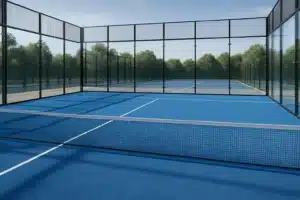
Padel courts have precise technical specifications and special requirements that distinguish them from courts for other sports. Understanding these requirements is essential for any investor seeking to build professional padel courts that meet international standards and provide an optimal playing experience.
Dimensions and technical specifications
meters. These are 4 meters to 3 meters and the side walls go from 3 meters, with the back walls being 10 meters high and 20 meters wide. The padel court has precisely defined dimensions according to international standards, with the exact dimensions necessary to ensure fair play and compliance with international standards.
centimeters at the ends. This difference in height affects the dynamics of the game and requires precision at 92 centimeters in the center and 88 centimeters in the center of the field.The net in the center of the field has special specifications for installation and maintenance.
Doorways and openings in the walls have specific dimensions and locations, with openings in the side walls having a specific height and width. These openings affect gameplay strategy and require careful design to ensure fair play.
The spaces around the stadium are important for safety and functionality, as sufficient space must be provided around the stadium for the safe movement of players and spectators. These spaces require careful planning, especially in locations with limited space.
Materials and construction
The name of this chassis is made so that the 20 or 15 boards are installedThe iron chassis is made of electrostatic and rust-resistant painted iron cans and is installed on a concrete base, the thickness of the jag on it, and there are several designs for the padel court chassis, such as the Standard, Panorama or Super Panorama design
12 mil for panoramic and super panoramic padel courts 12 mil for standard padel courts or 10 meters thickness 3 meters in 2Walls in padel courts are usually built of securite glass measured with special specifications in the installation on the iron chassis to ensure proper bounce of the ball, as the surface of the walls must be smooth from the glass to ensure a fair and expected bounce. This requires specialized expertise in installation.
The pitch requires a special type of artificial turf made specifically for padel courts, and the turf must be professionally installed to ensure that the ball is not deflected.
Padel court lighting systems require a special design that ensures uniform illumination without shadows or glare, as poor lighting affects the quality of play and player safety. This requires the use of advanced lighting technologies and precisely calculated locations.
Architectural Design and Planning
The orientation and location of the padel court is important to avoid sun and wind issues, as the correct orientation minimizes the impact of direct sunlight on players and improves playing conditions. This requires careful consideration of the location and local weather conditions.
Ventilation in covered padel courts requires a special design that ensures proper airflow without strong currents affecting the path of the ball, as the balance between adequate ventilation and not affecting play is complex and requires specialized expertise.
Support facilities such as changing rooms, reception, and cafes are an important part of the padel complex design, as these facilities improve the player experience and provide additional revenue streams. Integrated planning of these facilities improves functionality and profitability.
Access and parking require careful planning, especially in urban centers, where accessibility and parking availability are important factors in the success of the project. This planning must take into account peak hours and usage patterns.
Technical requirements and equipment
Electronic reservation and management systems have become essential in modern padel courts, as these systems make it easier for customers to book courts and help management improve the utilization of the courts. These technologies improve efficiency and customer experience.
Security and surveillance systems are important to protect facilities and users. These systems include surveillance cameras, alarm systems, and access control. Investing in security protects the investment and reassures customers.
Audio and communication systems are essential for effective operation, especially in large complexes, as these systems help in communicating with players and managing events. This includes public announcement and intercom systems.
Specialized maintenance and cleaning equipment is essential to maintain the quality of the courts, as padel courts require regular and specialized maintenance to maintain performance and appearance. Investing in the right equipment minimizes long-term maintenance costs.
The Egyptian market for padel courts: Opportunities and challenges
The Egyptian padel market is on the cusp of a rapid growth phase, driven by economic, social, and cultural factors that create an ideal environment for this new sport to flourish. Understanding the characteristics, opportunities and challenges of this emerging market is essential for investors looking to enter this promising space.
Current status and projected growth
The Egyptian market for padel courts is still in its infancy, with a limited number of courts currently available, mostly in Greater Cairo and Alexandria. This situation creates a golden opportunity for early investors who can capitalize on the lack of competition and build a strong customer base.
The expected growth in the Egyptian market is based on several strong factors, most notably continued economic growth, increased disposable income, and the development of sports and health awareness among Egyptians. These factors are creating a growing demand for new and exciting sports activities.
Egyptian youth are showing a growing interest in new and trendy sports, especially those that combine fun with a sporting challenge. Padel meets these needs perfectly, making it appealing to this important market segment.
High-end communities and modern residential complexes are looking for distinctive recreational and sports facilities to attract residents and increase real estate values. Padel courts are a perfect addition to these communities, creating investment opportunities in the residential sector.
Target Groups and Potential Customers
The upper and upper middle class is the primary target group for padel courts in Egypt, as these groups have the income and time to play new sports. They are also more open to new experiences and trendy sports.
Young people in their 20s and 30s are an important segment, especially those who work in modern industries such as technology and financial services. They are looking for social and sporting activities that help them network and build professional relationships.
High-income families represent a significant opportunity, as padel is a family-friendly sport that can be played as a family activity. This creates opportunities for family programs and group memberships that increase revenue.
Expatriates and foreign communities in Egypt, especially from countries where padel is popular, represent an important and lucrative sector. These customers are usually familiar with the sport and are willing to pay high prices for a high-quality experience.
Challenges in the local market
The lack of awareness of padel among the Egyptian public is a major challenge, as most Egyptians have never heard of the sport. This requires significant investments in marketing and publicizing the sport to build a customer base.
Competition from traditional sports such as football and tennis is a challenge, as these sports have a strong fan base and established infrastructure. Padel needs to prove its added value and differentiate itself from football’s 200 meters, especially since the return on investment rate is higher in padel compared to football and needs a smaller area, as padel’s stadium area is one meter.800 pentathlon
The high costs of building and operating stadiums can be an obstacle for some investors, especially in light of the need to import most of the specialized materials and equipment. This requires careful financial planning and good cost management.
The lack of local expertise in the design, construction, and operation of padel courts is a technical challenge, as this is a new field in Egypt and requires bringing in foreign experts or training local staff. This increases initial costs and requires time to build expertise.
Promising Investment Opportunities
Early market entry provides a golden opportunity to build a strong brand and gain customer loyalty before new competitors enter. Early investors can capitalize on the lack of competition and set market standards.
Partnering with real estate developers opens up great opportunities to integrate padel courts into new residential and commercial projects. These partnerships minimize risk and provide a guaranteed clientele of residents and tenants.
Developing training programs and academies for the exchange creates additional revenue streams and contributes to the popularization of the sport. These programs attract beginners and develop players’ skills, increasing the regular customer base.
Organizing sports tournaments and events can attract media attention and contribute to the marketing of sports. These events create excitement around the sport and attract new players and spectators.
Investing in padel courts: Feasibility study and returns
Investing in padel courts requires a comprehensive feasibility study that takes into account all financial, operational and market factors. This study is necessary to make an informed investment decision and determine the best operational models to achieve the desired returns.
Different investment models
The purely commercial model focuses on making money through hourly court rentals, monthly and annual memberships, and organizing tournaments and events. This model requires a good location and effective management to achieve high occupancy rates.
A hybrid model that combines stadiums with ancillary services such as cafes, sports shops, and training services provides diversified revenue streams and minimizes risk. This model is more complex but yields better returns.
A residential model that integrates padel courts into apartment complexes as a facility for residents generates returns by increasing property values and attracting buyers and renters. This model requires a partnership with real estate developers.
An educational model that focuses on academies and training aims to build a long-term player base and generates revenue from training fees and memberships. This model requires investment in coaches and educational programs.
Cost analysis and initial investment
Land and location costs vary greatly by region and city, with premium locations in high-end areas being more expensive but yielding better returns. Choosing the right location requires a balance between cost and expected return.
Building and construction costs include civil works, specialized materials, and technical equipment. These costs are influenced by the quality of the materials chosen and the level of finishes required, with savings possible through good planning and purchasing in bulk.
Equipment costs include lighting systems, sports equipment, and management systems. These costs can be optimized by choosing the right equipment for the level of service required without overspending.
The working capital needed to run the business in the first few months must be carefully estimated, as new ventures need time to build a customer base and achieve positive cash flow. This requires careful financial planning.
Sources of revenue and expected returns
Stadium rental revenue is the primary source of income, with the potential to realize different prices depending on time and demand. Managing this revenue effectively through dynamic pricing systems can significantly improve returns.
Monthly and annual memberships provide a stable and predictable income, with discounts for long-term memberships. This type of revenue helps with financial planning and minimizes income fluctuations.
Additional services such as training and academies, equipment rentals, and cafes add diverse revenue streams and improve the customer experience. These services typically generate high profit margins and increase overall customer value.
Organizing tournaments and events can generate good seasonal revenue, as well as marketing and promotional benefits. These events attract media attention and contribute to building the center’s reputation.
Risk assessment and management
Market risks include slow demand growth or changing customer trends, as padel sports are new to Egypt and may face challenges in spreading. These risks can be mitigated through effective marketing and outreach programs.
Operational risks include maintenance issues, lack of trained personnel, or quality issues. These risks require good maintenance planning, staff training, and quality control systems.
Financial risks such as exchange rate fluctuations or rising operational costs can affect profitability. Managing these risks requires careful financial planning and possibly hedging some of the risks.
Competitive risks from the entry of new competitors or the development of other alternatives require a strong competitive strategy and continuous development of services. Building customer loyalty and developing sustainable competitive advantages are essential.
Technical advances and innovations in padel courts
The world of padel courts is witnessing rapid and continuous technological developments aimed at improving the player experience, increasing operational efficiency, and developing new possibilities for the sport. These developments are creating opportunities for investors who embrace new technologies and offer differentiated experiences for their customers.
Smart and digital technologies
Smart reservation systems use artificial intelligence to optimize stadium utilization and provide a seamless customer experience, as these systems learn from usage patterns and suggest convenient times for customers. This improves customer satisfaction and increases revenue.
Customized smartphone apps for padel courts offer comprehensive services from booking to training and socializing, as these apps create a digital community around the sport and increase customer engagement with the center.
Performance analytics systems using cameras and AI help players improve their skills by analyzing their movements and providing personalized advice. These technologies add great value to the service and attract serious players.
Digital payment systems and e-wallets make it easier for customers to pay and reduce cash handling, improving efficiency and minimizing security risks. These systems are essential in the digital age.
Training and development techniques
Simulation and virtual reality systems help train players and develop their skills without the need for a real stadium, as these technologies allow practicing different scenarios and analyzing performance accurately. This opens up new possibilities for training and education.
Real-time feedback systems that provide tips and analytics to players as they play help in rapid improvement and increase the enjoyment of the game, as these systems use sensors and cameras to monitor performance.
Customized training programs that adapt to the level and skills of each player provide a unique and effective learning experience, as these programs use artificial intelligence to analyze strengths and weaknesses and provide appropriate exercises.
Specialized social media platforms for padel players create sports communities and help organize matches and tournaments, as these platforms connect players and make it easier for them to find suitable partners and opponents.
Conclusion: The future of padel courts in Egypt
Padel is on the cusp of a real revolution in Egypt, fueled by strong economic growth, an evolution in sports awareness, and increasing demand for healthy and fun lifestyles. This exceptional sport combines the ease of learning with the excitement of playing, making it ideal for Egypt’s diverse and active market.
Investment opportunities in padel courts in Egypt are vast and varied, from purely commercial projects to residential complexes and training academies. Investors who enter this market early will be ideally positioned to capitalize on the exponential growth expected in the coming years.
Understanding the needs of the local market, developing effective marketing programs, and investing in quality and service are essential. Projects that focus on delivering a holistic experience will achieve the best results.
Rapid technological developments in the padel court industry open up new and exciting possibilities to improve the player experience and increase operational efficiency. Investors who embrace these technologies and invest in innovation will realize sustainable competitive advantages.
Egypt has all the ingredients to become a regional center for padel, from the strategic location and favorable climate to an active youth and a developing economy. This privileged location opens up opportunities for export and regional expansion in the future.
Investing in padel courts is not just a business venture, but a contribution to building a better sporting future for Egypt and developing a new and thriving sports industry. This investment brings excellent financial returns as well as a positive impact on society and public health.
With the rapid growth of padel globally and the huge potential in the Egyptian market, now is the perfect time to invest in this promising field. Investors who act now will be part of an extraordinary success story that will shape the future of the sport in Egypt and the region.
About Technotrade Sports:
Technotrade Sports is a pioneer in the field of specialized sports fields in Egypt, with extensive experience in designing and building padel courts according to the latest international standards. Our team of specialized experts offers comprehensive solutions from initial design to operation and maintenance, with a focus on quality, innovation and sustainability.
We understand the unique characteristics of the Egyptian market and offer tailor-made solutions to meet the needs of our local clients. Our expertise in sports fields enables us to provide valuable advice on best practices in the design and operation of padel courts.
We are committed to helping our clients capitalize on the tremendous investment opportunities in the padel court industry by providing integrated services that include feasibility studies and implementation. Our goal is to ensure the success of our clients’ projects and maximize returns on their investments.
For a personalized consultation on your padel court project or to discuss investment opportunities in this promising field, contact us today. We’re here to help you turn your vision into a successful and profitable reality, taking full advantage of the potential of the growing Egyptian market.
 Are You Looking for the Best Solutions to Equip your Fields with Artificial Turf?
 Call us now |
  Contact us via WhatsApp |