


Creating a basketball court is an important step in providing a safe and enjoyable sporting environment, whether in schools, clubs or community spaces. With the growing interest in basketball in the Arab world, good planning, choosing the right materials and technical design according to the approved standards have become essential factors in implementing a successful project, and in this article, we review the steps of creating a professional basketball court, from determining the area and choosing the type of floor, to implementing legal drawings and basic equipment, focusing on technical specifications and the most important tips to achieve quality and safety.
*** Translated with www.DeepL.com/Translator (free version) ***
You can learn about topics of interest to you by checking out our previous articles!
Top 5 Types of Court Flooring: Advantages and Prices of Acrylic Flooring
Cost of building a squash court – Building squash courts

Steps to build a basketball court
Building a basketball court requires careful planning and thoughtful execution to ensure quality and durability, as well as adherence to the technical specifications approved by the International Basketball Federation (FIBA). Here are the most important steps for building a professional basketball court:
- Choosing the right location
- The basketball court floor must be level and free of obstructions.
- In the case of outdoor playgrounds, the location should preferably be well-ventilated and have access to natural lighting.
- Ensure good drainage of rainwater.
- Land preparation and leveling
- The ground is cleared of any debris or plants.
- The soil is leveled and compacted well using heavy equipment.
- For outdoor playgrounds, it is preferable to create a waterproofing layer or concrete base to ensure stability.
- Pouring the concrete base
- A concrete layer of suitable thickness (usually between 10 to 15 cm) is poured.
- Ensure there are slight slopes for water drainage.
- Allow the surface to dry completely before applying the final coats.
- Choosing the type of sports flooring:
Flooring varies according to the type of use:- Acrylic: Suitable for outdoor courts, resistant to heat and moisture.
- Wooden parquet: Used in indoor courts, gives professional performance.
- Rubber (PU or EPDM): Suitable for schools and multi-purpose playgrounds.
- Determine legal dimensions and measurements
according to FIBA standards:- Length: 28 meters
- Width: 15 meters
- Floor painting and striping
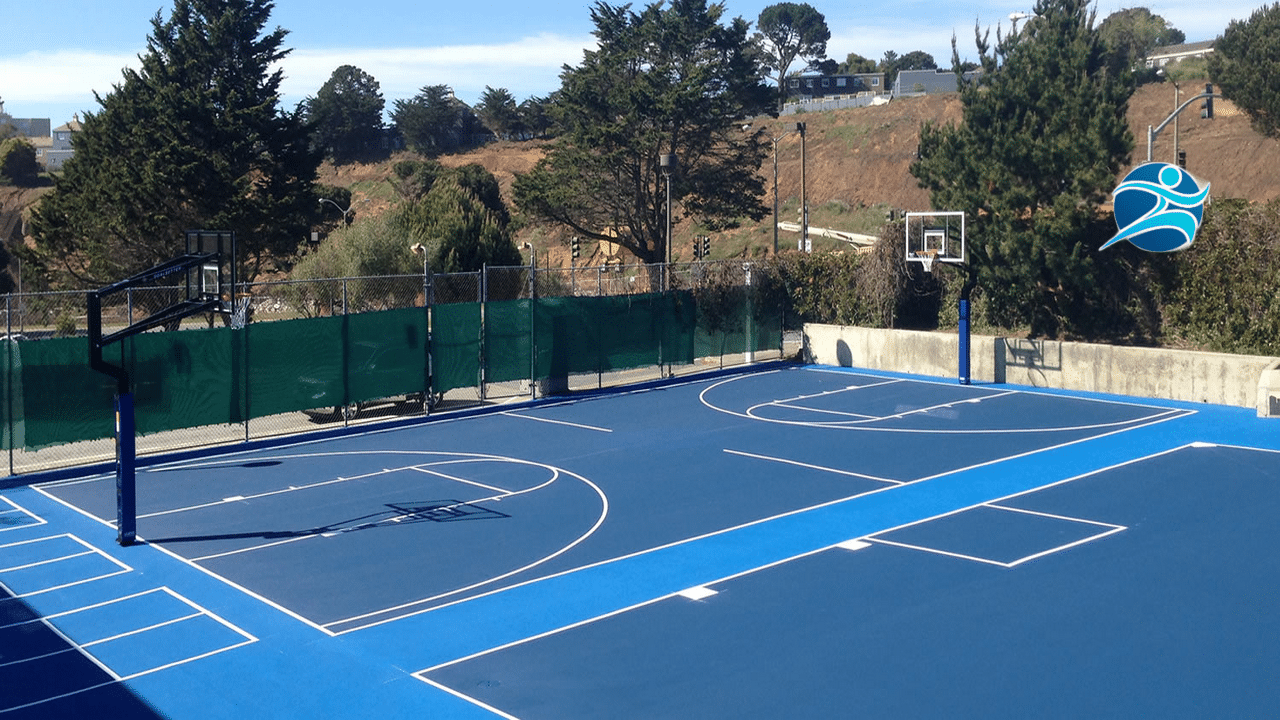
- The floor is painted in appropriate colors (usually orange or blue).
- The lines are drawn using abrasion-resistant and water-resistant paints.
- Accuracy in measurements is required.
- Installation of baskets and poles
- Two baskets are installed at a height of 3.05 meters.
- Fixed or adjustable baskets can be used depending on the type of use.
- The poles should be covered with a protective insulator to avoid injuries.
- Adding additional lighting and fixtures
- In indoor stadiums, strong and appropriately distributed lighting must be installed.
- Electronic scoreboards, player seats, and protective netting can be added to open fields.
- Periodic maintenance
- Regular maintenance of the floor and baskets is required.
- Ensure the lines are intact and that the upper layers of the floor are not eroded.
What is the best flooring for a basketball court?
Choosing the ideal flooring for a basketball court depends on several factors, such as: the type of court (indoor or outdoor), the target age group, the budget, and the level of use (training, entertainment, official competitions). The following are the most suitable types of flooring:
1. Hardwood Flooring
It is considered the best for indoor playgrounds and building a basketball court. Its most important details are as follows:
- Features:
- NBA – FIBAApproved for international tournaments ( ).
- Provides perfect ball bounce.
- Minimizes the impact of trauma on the joints.
- Gives a professional and luxurious look.
- Disadvantages:
- High cost.
- Not suitable for damp places.
- Needs careful periodic maintenance.
2. Acrylic flooring
Acrylic flooring is the best choice for outdoor courts, so it is an excellent choice when constructing an outdoor basketball court and is characterized by the following:
- Features:
- Resistant to sunlight and weathering.
- Non-slip.
- Easy to implement and maintain.
- Suitable for schools and sports centers.
- Disadvantages:
- Less flexible than parquet.
- They may corrode over time if not properly maintained.
3. Polyurethane (PU) or EPDM flooring
It is a multi-purpose option when creating a basketball court as it has many advantages that make it a very safe solution and yet it has many disadvantages, so familiarize yourself with the advantages and disadvantages as follows:
- Features:
- Flexible and safe for children.
- Shock and water resistant.
- Suitable for school or multi-sport fields.
- Disadvantages:
- They don’t give the same professional performance as parquet or acrylic.
- You may need a special concrete base.
4. Vinyl Sport Flooring
It may not be one of the best options when creating a basketball court, but it can suit many circumstances due to its advantages, so learn more details:
- Features:
- A relatively economical option.
- Corrosion resistant and easy to clean.
- Suitable for use in schools or multi-purpose halls.
- Disadvantages:
- Less professional.
- May not withstand heavy use for long periods of time.
Basketball court sizes
The dimensions of a basketball court must be accurate to ensure legal and fair play according to FIBA standards, these dimensions are used in international tournaments, below are the detailed measurements:
- Full pitch dimensions:
- meter28Length:
- meter15Width:
- Basket height:
- Ring height from ground: 3.05 meters
- Ring diameter: 45 cm
- Distance from back panel to ring: about 15cm
- Free throw zone:
- Distance from the backboard to the free throw line: 4.6 meters
- Free throw area width (rectangle): 4.9 meters
- Free throw circle radius: 1.8 meters
- Three-point area:
- Distance from basket to three-point arc: 6.75 meters
- Distance from corner (closest point of arc): approximately 6.6 meters
- Central circle:
- Radius: 1.8 meters
- Color: Often the same color as the ground or a distinctive color with a white outer stripe.
- Starting Area Distance (Side Line):
Any external obstructions must be at least 2 metres away from the field boundaries on each side to ensure player safety.
Kids Basketball Court Dimensions
The dimensions of a children’s basketball court vary depending on age, but there are approved dimensions used in schools and sports academies, which are as follows:
- Children from 6 to 8 years old (preparatory stage):
- Length: 14 meters
- Width: 7 to 8 meters
- Basket height: 2.60 meters
- Distance to the free throw line: 3 meters
- Distance to the three-point arc: Often not applied or only symbolic
- Children from 9 to 11 years old:
- Length: 20 meters
- Width: 10 to 12 meters
- Basket height: 2.75 to 2.85 meters
- Free throw line: approximately 4 meters
- Three-point arc: 5 meters (optional)
- Children from 12 to 14 years old:
- Length: 22 to 24 meters
- Width: 12 to 13 meters
- Basket height: 3.05 meters (same as official height)
- Other distances are close to the official measurements with some accommodations.
How much does it cost to build a basketball court?
The cost of building a basketball court varies from one project to another, depending on a number of technical and financial factors. Here are the most prominent elements that directly affect the total cost:
- Location and area
- Type of land: If the land is uneven or needs to be leveled or engineered, the cost will increase.
- Total area: The larger the dimensions of the stadium and the surrounding area (such as seating areas or services), the higher the cost.
- Accessibility: If the area is remote or difficult to access, transportation and equipment costs may increase.
- Construction works and foundation
- Excavation, backfilling and ground leveling works.
- Pour the concrete base to a suitable thickness (usually between 10-15 cm).
- Waterproofing and drainage for outdoor playgrounds.
- Sports floor type
- Wooden parquet: expensive – for official indoor courts.
- Acrylic: Medium cost – suitable for outdoor courts.
- PU or EPDM rubber: Medium to high cost depending on quality.
- Vinyl: Less expensive – for light interior use.
- Installation of baskets and panels
- Basket type (fixed or mobile – conventional or hydraulic).
- Materials used in the manufacture of poles (galvanized steel or aluminum).
- Backplate price (glass – acrylic – polycarbonate).
- Paint and lines
- Cost of painting the floor with abrasion resistant colors.
- Execute the official lines accurately according to FIBA specifications.
- Add custom logos or graphics (optional).
- Lighting and additional equipment
- Number and type of lighting units (LED – high power spotlights).
- Player seats, electronic scoreboards, umbrellas, protective nets.
- Future maintenance costs
- It varies depending on the type of soil and climate.
- Parquet is relatively expensive to maintain, while acrylic is less expensive to maintain.
- Licensing and Engineering Consultations
- Permit fees from local authorities.
- Cost of preparing engineering design and technical drawings.
- Fees of engineers or specialized companies.
Top 10 Tips for Building a Basketball Court
- Choose a location carefully.
When building a basketball court, choose a level location that is easy to access and away from sources of disturbance or danger (such as highways or construction areas). - Adherence to legal dimensions:
Ensure the official dimensions of the court are adhered to (28 x 15 metres for adults), with an additional safety space of at least two metres around the court. - Choosing the right flooring
when building a basketball court: Determine the type of flooring based on the court’s use: parquet for professional indoor courts, acrylic or rubber (PU) for outdoor courts and schools. - Prepare a strong concrete base.
Ensure that the concrete base is solid and executed to an appropriate thickness (usually 10–15 cm), with a slight slope to drain water in outdoor playgrounds. - Use weather-resistant materials
on outdoor playgrounds. Use materials that are resistant to sunlight, rain, and moisture to ensure the playground stays in good condition for a long time. - Provide safety measures:
Install baskets with guarded or covered handles, and add protective netting around the playground, especially if it is in an open area or used by children. - Install sufficient and effective lighting.
If the stadium is intended for night use, install high-quality LED lights evenly distributed to cover the entire stadium without shadows. - Paint and precise lines:
Draw the legal lines accurately using abrasion-resistant paints, taking into account the official dimensions approved by FIBA. - Provide auxiliary facilities
If space allows, add benches, umbrellas for shade, or a tool locker for sports equipment. - Develop a regular maintenance plan.
Establish a regular schedule for inspecting the floor, installing baskets, and cleaning surfaces to maintain the quality of the field and the safety of the players. - Additional advice:
Hire an engineer or a company specializing in stadium construction to ensure the project is implemented according to international standards and the required quality. Therefore, you can rely on Technotrade Sports, a professional company in designing and constructing stadiums of all types. Visit the contact page on its official website for inquiries: https://technotradesports.com .
We offer you a comprehensive guide to building a basketball court, downloadable in PDF format. Click here to download .
In conclusion, building a basketball court is an important sports and investment project that contributes to promoting physical activity and encouraging youth to practice sports in a safe environment that complies with international standards. With careful planning, the selection of appropriate materials, and consideration of quality and safety factors, a fully integrated court can be efficiently constructed to serve educational, recreational, or competitive purposes. There is no doubt that regular maintenance and continuous development of the court prolongs its lifespan and maintains the desired level of athletic performance.
 Are You Looking for the Best Solutions to Equip your Fields with Artificial Turf?
 Call us now |
  Contact us via WhatsApp |